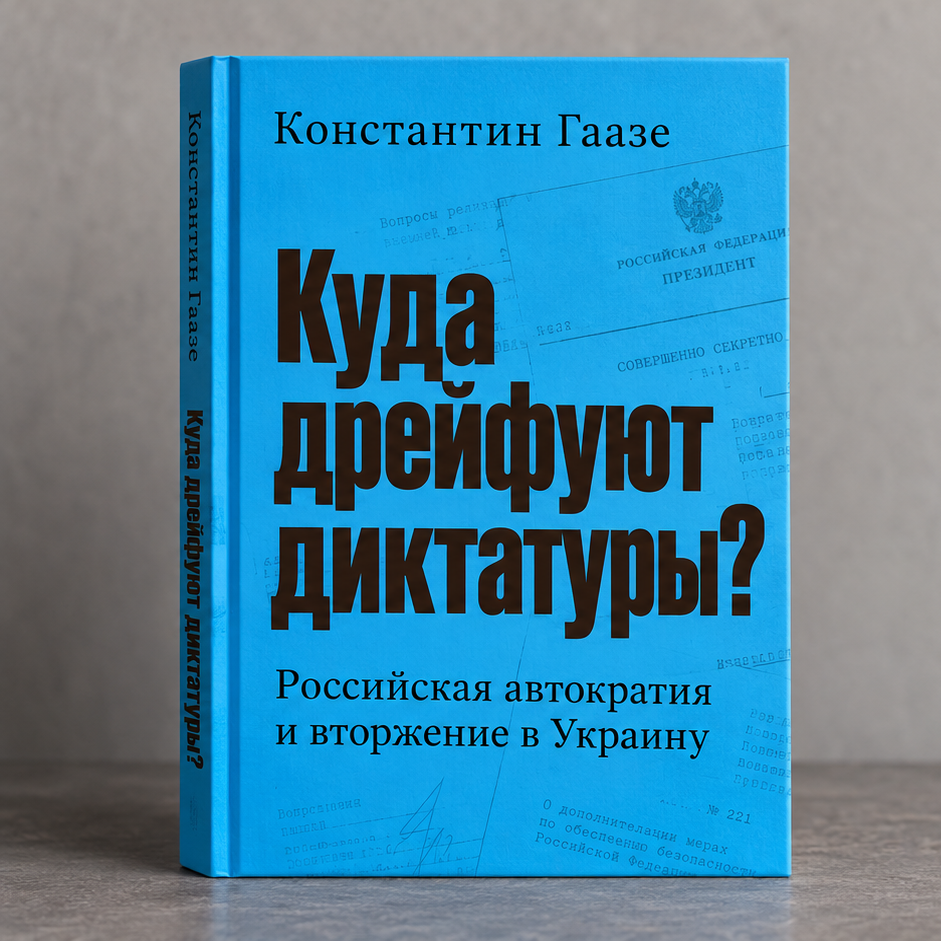
Konstantin Gaaze sets himself a difficult task: to explain how the Russian government arrived at its full-scale invasion of Ukraine. In Where Do Dictatorships Drift? Russian Autocracy and the Invasion of Ukraine published by Meduza in 2025, he rejects two familiar answers: that the war was predetermined by Russia’s history, or that Putin’s personality alone explains it. Instead, Gaaze traces changes within the regime—in its understanding of threats, its decision-making, and its relationship with society.
I began the book with considerable interest. Gaaze is an attentive and gifted observer of Russian government. He shows how it operates from day to day, and how decisions whose consequences become clear only years later can initially appear reasonable and limited to those making them. That makes my disappointment with the book’s central argument all the greater.
Gaaze describes several mechanisms that made war possible. He is much less convincing, in my view, about where those mechanisms came from and why they led to this particular outcome.
While I was thinking through that question, a recent appearance by Gaaze on The Breakfast Show raised a different question about the relationship between the Russian state and the people living under it. I will return to that controversy after discussing the book. The book deserves attention on its own terms, including where its account of Russian power is most illuminating.
What Gaaze Gets Right
The book is at its strongest when Gaaze works with internal documents and reconstructs the workings of government. We usually judge Kremlin decisions from public statements and their eventual consequences. The documents reveal what lies between the two: which problems officials discussed, which scenarios they considered possible, how they described risks, and what they proposed to their superiors. This material is valuable even when one disputes Gaaze’s interpretation of it.
His account of the gradual breakdown of feedback is also important. In a personalist regime, bringing bad news can become dangerous for the messenger. Disagreement increasingly looks like disloyalty, while advancement depends on anticipating what superiors want to hear. Those at the top consequently receive less information that might challenge their view of the world. Gaaze shows how this pattern emerges from ordinary decisions and relationships within the state apparatus. The resulting errors need not depend on anyone deliberately setting out to deceive the leader.
His observations about the depoliticisation of society are similarly persuasive. Political questions—about the purposes of the state, the distribution of resources, and the possibility of choosing a different course—are increasingly treated as matters of administration. Citizens are cast as recipients of services, implementers of decisions, or spectators. The government becomes less willing to recognise society as an independent political actor, while society loses some of the means to act as one. This process began long before Putin. One achievement of the book is to show how it continued and became more deeply entrenched under his rule.
Finally, Gaaze offers an intriguing account of ideology as something more than public rhetoric. In his telling, it gradually shapes the work of government, defining acceptable arguments and filtering the proposals that reach decision makers. I find this worth considering, though Boris Kagarlitsky raised an important objection in a later letter to me. Ideology has independent force when it is built into institutions, procedures and material commitments, as it was in the Soviet Union. He doubts that contemporary Russia meets that test. What appears to be ideology shaping policy may instead be propaganda that justifies decisions after they have been made—and an industry through which state resources are distributed to loyal groups. Gaaze’s observation about the language of power is valuable, but he needs to show that this language actually governs decisions rather than follows and rewards them.
These insights make the book a valuable study of late Putinism. Yet showing how damaged feedback, depoliticisation, and ideology operate does not by itself explain why this particular regime emerged or why it chose war. Answering those questions requires closer attention to the regime’s social base, the structure of the Russian economy, and the interests of groups able to influence state decisions. That is where, I think, the central disagreement with Gaaze begins.
Does Autocracy Drift Toward War?
Gaaze repeatedly acknowledges that history is contingent. Political leaders make choices; circumstances change; a different decision remains possible until it is made. Yet the architecture of his argument leaves a different impression. Fear of losing control encourages the ruler to concentrate power. Concentrated power weakens feedback. Weaker feedback makes external threats appear more alarming. Ideology narrows the range of acceptable responses, while the state develops the capacity to withstand a confrontation. Almost every mechanism Gaaze describes moves the story closer to war.
There is a difference between showing how war became possible and demonstrating that the internal logic of a personalist autocracy made it increasingly likely. The latter claim requires us to ask what else could have happened. Could a regime have concentrated power, curtailed public debate and prepared for external shocks without starting a major war? What circumstances made that course less attractive to Russia’s rulers? If the answer lies partly in Russia’s economy, its ruling groups or its relationship with Ukraine, then the argument needs to say so. Autocracy alone cannot carry the explanatory burden.
The comparison with other regimes makes this problem clearer. During my years working in Uganda, I saw no indication that President Museveni’s regime was drifting toward a large external war because of its personalist character. This is not to suggest that Uganda has avoided military interventions or regional conflict. It is to ask whether the pressures Gaaze identifies point toward a particular outcome even when the surrounding political and economic conditions differ. Serbia offers another, closer case. Its increasingly concentrated power, nationalist politics and tensions over Kosovo warrant serious concern. Yet it would be difficult to infer from the character of its domestic regime alone that a major external war is the direction in which it must move.
Neither example disproves Gaaze’s account of Russia. They do, however, put pressure on the question posed by his title. If personalist regimes can respond to insecurity through accommodation, repression at home, bargaining abroad or military force, what explains the selection of one path over another? Perhaps the book describes a particular kind of autocracy under particular conditions rather than the drift of dictatorships in general. That would still be an important argument. It would also call for a more precise account of those conditions.
In a letter responding to my thoughts on the book, Boris Kagarlitsky put the problem in terms of cause and effect: war, he wrote, is an unsuccessful way of trying to resolve systemic contradictions. The proposition invites further questions. Which contradictions were Russian leaders attempting to manage? Why did they come to see war as a viable response?
Fear: Explanation or Consequence?
Fear occupies a central place in Gaaze’s account. A personalist ruler fears losing power; the regime fears threats it cannot control; the circle around the ruler increasingly interprets events through the same lens. Gaaze contrasts this with democracies, whose institutions, he argues, allow them to confront uncertainty and correct their course. Autocracies, deprived of those mechanisms, become increasingly governed by fear, which helps propel their drift towards confrontation and war.
There is something persuasive in the institutional part of this argument. Open debate and independent scrutiny can expose mistaken assumptions before they become policy. But the contrast becomes much less convincing when it takes on a psychological character. Democracies are hardly free from fear. At the recent UN General Assembly, Donald Trump warned of communist networks in the United States. European leaders spoke of risks posed by artificial intelligence and of the need to rearm; several East European leaders also invoked the memory of communist rule. These concerns have different histories and deserve to be assessed on their own merits. Together, however, they make it difficult to portray democratic politics as a fearless encounter with the future. The relevant question is whether democratic institutions allow such claims about threats to be challenged—and whether leaders respond to them with proportionate judgment.
Boris made a related point particularly sharply in his letter. He objected to treating psychological states as explanations of systemic processes: “You destroy the channels of feedback, drive yourself into a corner, and then become frightened. Elementary, my dear Watson!” His phrasing deliberately reverses the apparent sequence. Fear may shape a decision while itself being the product of earlier decisions and of the political system in which they were made.
That does not mean psychology is irrelevant. Leaders can misjudge threats, cling to reassuring advisers and act on deeply held convictions. The question is why a particular government permits those tendencies to become decisive. Who can contradict the leader without losing their position? Which institutions can test assumptions against evidence? Why were such constraints weakened, and whose interests were served by weakening them? Without answers, “the ruler was afraid” risks becoming a description of the final stage of a process rather than an explanation of the process as a whole.
Boris goes further, suggesting that personalist rule may arise from the weakness and instability of a regime’s social base. He does not regard personalism as necessarily autocratic: in his letter he points to Perón’s Argentina and Chávez’s Venezuela alongside more authoritarian cases. One need not accept every comparison to recognise the challenge. If personalist power is itself a response to unresolved social conflicts, we cannot explain its conduct solely by looking inside the ruler’s mind or at the institutions surrounding him. We must also ask what holds the regime together—and what threatens to pull it apart.
Who Pays, Who Benefits?
Gaaze repeatedly observes that “the population as a whole” pays for the choices of the regime. They do, but the costs are distributed unequally—and so are the benefits. This is where the absence of class analysis matters most. Which groups have a material stake in the existing order? How did their relationships with the state change as Russia moved toward confrontation, and how have they changed again during the war?
Russia’s economy cannot be understood simply as the economic setting in which an autocracy operates. Russia occupies a contradictory position in the world-system: dependent on global markets for resource revenues, technology and the preservation of elite wealth, yet powerful enough to dominate weaker neighbours. Resource exports, access to state contracts and control over public assets have long tied the accumulation of wealth to political power. Much of the capitalist class depended on the state for privileged access to rents while holding and investing its wealth abroad. With limited incentives for productive investment at home, this pattern generated capital outflows rather than sustained diversification. When opportunities for accumulation abroad became more constrained, expanding influence over neighbouring economies could appear to the ruling elite as one way to secure markets, assets and political control. As I have argued in my analysis of Russia’s peripheral accumulation regime, these pressures helped shape the choices available to political leaders. They did not dictate a decision to invade Ukraine.
Boris Kagarlitsky and I examine these divisions in “Russia as an Empire of the Periphery: War and the Crisis of Dependent Accumulation,” our chapter for the forthcoming Suhrkamp anthology (Anti-) Imperialism. We ask how a state capable of dominating its neighbours remains shaped by a dependent pattern of capitalist development, and how war changes the distribution of resources within that state. The chapter’s figures give some measure of the shift. Federal defence spending rose from roughly 3.5 trillion roubles in 2021 to more than 13 trillion in 2025, increasing from about 15% to over 30% of federal expenditure. Over the same period, the combined share allocated to social policy, healthcare and education fell from nearly 37% to about 25%, though spending on these services continued to rise in nominal terms.

At the top of the distribution, the sanctions shock proved short-lived. Our calculations from Forbes data show that the combined wealth of Russia’s 15 richest individuals fell in 2022, surpassed its 2019 level by 2023 and rose further through 2026. Resource fortunes and the value of state-connected businesses do not all rise for the same reason, but this recovery makes it difficult to describe the war as a uniform sacrifice by “ordinary Russians.” Wartime procurement, subsidised finance and protection from competition have created further opportunities for politically connected capital. Meanwhile, household debt rose from 27.6 trillion roubles in early 2022 to more than 43 trillion by early 2026, and wage gains have become increasingly concentrated in sectors supported by state demand.
These figures do not establish that today’s beneficiaries wanted the invasion in 2022. The origins of the war must be distinguished from the interests that have grown around its continuation. They do show a redistribution of opportunities and burdens across classes and sectors. For some groups, ending the war may now threaten an established source of income and influence; others have borne its costs without gaining a say in the decisions that produced them. Understanding responsibility therefore requires attention to what different people did, what power they held and how they related to the war. A recent statement by Gaaze moves in the opposite direction.
The Video: From Political Responsibility to Criminal Guilt
On 19 September 2026, Gaaze appeared on The Breakfast Show during a discussion of Russian elections. He said: “Living in the territory of an aggressor state violates international law; citizenship of that state makes you an international criminal.” The statement prompted a heated argument about collective responsibility.
There are several different questions here. Russia bears responsibility as a state for its aggression against Ukraine. Individuals may bear criminal responsibility for particular acts, including war crimes; the crime of aggression concerns people able to direct a state’s political or military action. Citizens may also face moral and political questions about what they supported, opposed or chose to ignore. But international criminal law does not make residence or citizenship a crime. It requires an account of what a particular person did.
One can argue about whether citizens share some collective political responsibility for the actions of their government. What I find especially troubling in Gaaze’s statement is the criterion he chooses. Residence places an official who helped organise the war in the same category as someone imprisoned for opposing it. Boris Kagarlitsky, with whom I have exchanged letters about Gaaze’s book, remains in Russia because he is in prison. His opposition to the war is part of the reason he is there. His location cannot make him complicit in the actions of those who imprisoned him.
The criterion also produces a strange account of how responsibility ends. Imagine a longtime supporter of the invasion leaving Russia while an opponent remains to care for family or continue political work. If residence determines culpability, crossing the border changes the first person’s status while the second remains condemned. Gaaze’s reference to citizenship makes the argument still more confused: moving abroad does not ordinarily end one’s citizenship. Neither interpretation tells us much about what either person has done.
This returns us to the class question missing from the book. The costs of the war and the benefits of the political and economic order that sustains it are distributed unequally. So is the ability to leave. Emigration requires money, documents, contacts and a way to support oneself elsewhere. Those resources are shaped by class position; family obligations, age, health and the risk of prosecution narrow the choice further. Some people able to leave benefited from the system. Some who resisted it cannot leave. Treating departure as a sign of innocence would convert economic privilege into moral standing while overlooking the interests that actually connect particular groups to the war.
There is a political consequence as well. Gaaze’s book offers valuable insights into how Russians were deprived of opportunities for collective political action. His statement on The Breakfast Show risks erasing the agency of those who still oppose the war from within Russia. If their continued presence makes them criminals by definition, their resistance becomes invisible. A serious account of responsibility must instead distinguish those who made decisions, those who gained from them, those who carried them out and those who challenged them—wherever they live.
Conclusion
Gaaze’s account of damaged feedback, depoliticisation and the narrowing of political choices offers interesting insight into the Russian state. Yet his explanation of its drift towards war gives fear too much causal weight. As Boris argued in his letter, war can be an unsuccessful attempt to resolve systemic contradictions. To understand why Russia’s rulers chose it, we must examine the regime’s social base and accumulation regime alongside its institutions and ideas.
Those structural pressures did not make the invasion inevitable or absolve those who ordered it. Political leaders made choices, and those choices have since created new beneficiaries and new obstacles to peace. The costs, meanwhile, have fallen unequally on people with very different degrees of power over the war.
Gaaze’s interview makes the distinction especially urgent. Russia bears responsibility for its aggression, and individuals bear responsibility for what they planned, ordered or did. Residence establishes none of those things. It tells us neither who benefits from the war nor who resists it, sometimes at great personal cost.
Gaaze asks where dictatorships drift. His answer—that fear propels them towards war—is unconvincing. The more revealing questions are what drives a particular regime, who can steer it, and who bears the consequences of its decisions.