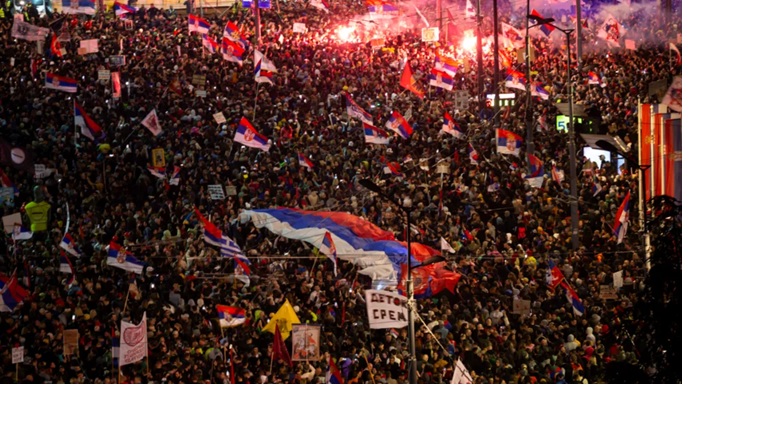
In a previous article, I analyzed the economic consequences of the protests. As I noted (and the figures for the first quarter of this year, published by the Statistical Office of the Republic, clearly confirm), despite the alarmist statements of officials, the Serbian economy has not suffered serious damage. On the contrary, real GDP growth in the first quarter of 2025 compared to the same period of the previous year amounted to 2.0%, goods exports (measured in euros) increased by 1.8%, and in March there was a 6.9% increase in industrial production compared to March 2024. As Lenin once said, facts are stubborn things (факты — упрямая вещь).
Of course, citizens rarely get excited about aggregate indicators such as GDP or industrial production. They care about what they directly feel in their wallets—prices and wages. But even there, the data offers no reason for drama. The inflation rate has not changed significantly and has even slightly decreased—from 4.6% in January to 4.0% in April 2025. Compared to the same month of the previous year, average gross and net wages for March 2025 are nominally higher by 10.0%, and in real terms by 5.3%.
Even when certain signs of economic slowdown are observed, as noted by Kori Udovički—such as a decline in public capital expenditures, which, despite expectations of acceleration especially in the context of EXPO preparations, actually fell by 3.7% nominally and 7.8% in real terms in the first quarter—or the drop in foreign direct investment, especially in manufacturing—these trends are not the result of the protests, but rather the product of the government’s export-oriented policy, which systematically neglects the development of the domestic market and internal consumption.
But even if the economy had indeed suffered damage, how would that affect the political situation? Could a deterioration in economic indicators increase public dissatisfaction and lead to a change of regime? What does economic theory say about this—and what does historical experience teach us?
At first glance, it seems that the economic situation and the level of support for a regime are closely linked. Satisfied people don’t seek change—as the well-known saying in political circles goes, “You don’t change a horse that’s winning the race.” However, reality is more complex. Protests and political changes don’t necessarily erupt when the economic situation is at its worst, nor does regime stability depend solely on the state of the economy.
The Fragility of Performance Legitimacy
Analyzing the signs of a revolutionary situation based on the Russian revolutionary experience in the early 20th century, Lenin identified as one of them “a worsening, beyond the usual, of the needs and misery of the oppressed classes.” But this sign, though necessary, is not sufficient—nor even decisive—because it must be combined with other factors, such as the inability of the ruling classes to continue ruling in the old way, and the subjective strength of the working class: their class consciousness, organization, and determination for revolutionary action.
Hence, economic crises rarely topple authoritarian regimes on their own — but they often shake the pillars that keep such regimes standing. In systems where legitimacy is not derived from electoral processes, free media, or civil liberties, economic performance becomes one of the few remaining foundations of political authority. And when that foundation begins to crack, the consequences can reverberate far beyond GDP figures.
This vulnerability is structural. Authoritarian governments tend to rely heavily on what political scientists call performance legitimacy — the promise of stability, prosperity, and order. This is especially true in semi-peripheral contexts like Serbia, where regimes lack strong ideological foundations and possess only limited democratic credentials. Without genuinely competitive elections or robust institutional channels linking rulers and ruled, authoritarian leaders are compelled to justify their continued rule through outcomes — or, more often, the perception of outcomes.
As Johannes Gerschewski argues, legitimation through economic performance — such as GDP growth, wage increases, or macroeconomic stability — becomes particularly important for non-democratic regimes, whose “repertoire” of legitimation is narrower than that of democracies. Whereas democratic legitimacy draws primarily on procedural norms, electoral competition, and institutional continuity, autocracies rely on economic success as a compensatory narrative. It functions as a second-order justification for rule — one that gains urgency when democratic mechanisms are absent or hollowed out.
This makes authoritarian regimes acutely vulnerable to economic turbulence. A major downturn typically undermines their rule in at least four ways:
- It erodes living standards, pushing people into the streets and undermining the regime’s social contract.
- It drains public coffers, reducing the funds available for patronage, elite loyalty, and coercive capacity.
- It exposes state dysfunction, weakening perceptions of competence and emboldening both internal dissent and external pressure.
- It intensifies competition within the elite, as shrinking public resources force rival factions into a zero-sum struggle over what remains of the state-controlled pie — increasing the risk of fragmentation, defection, or intra-elite coups.
Crisis and the Ambiguity of Political Outcomes
While economic hardships alone are not sufficient to trigger social upheaval, economic crises do not automatically lead to democratization either. The direction of political change is not determined by the severity of the downturn but by how that downturn is interpreted, organized, and contested. As history shows, recessions can be as much a breeding ground for dictatorship as for democracy.
In the 20th century, some of the most notorious authoritarian regimes rose to power by exploiting economic collapse. In Weimar Germany and post-liberal Italy, fascist movements capitalized on mass unemployment, inflation, and political paralysis. In Latin America, military dictatorships in Brazil (1964), Chile (1973), Argentina (1976), Ghana (1981), Nigeria (1983), seized power under the pretext that elected governments had mismanaged the economy. The generals portrayed themselves not as usurpers but as national saviors — restoring discipline, rationality, and economic order. Their justification was clear: democracy had failed to deliver, so it had to be suspended.
The experience of Yugoslavia and Serbia under Milošević, however, illustrates that even severe and prolonged economic crises do not necessarily result in regime collapse. In the 1980s, Yugoslavia’s economic disintegration — marked by foreign debt, IMF restructuring, and regional disparities — contributed to growing tensions, but as Dejan Jović (2024) and others have shown, the dissolution of the state was driven more by political fragmentation and competing nationalisms than by economic breakdown alone. Likewise, during the 1990s, Serbia endured hyperinflation, sanctions, and the collapse of real incomes, yet the Milošević regime survived — until it lost its political legitimacy following the fraudulent elections of 2000.
Why Don’t People Revolt? A Rational Choice Perspective
This brings us to a useful bridge with Acemoglu and Robinson’s theory of the economic origins of dictatorship and democracy. While their broader analytical framework has been rightly criticized — including in my own work — for treating capitalism and globalization too uncritically, their formal modeling of elite–citizen dynamics remains relevant and insightful, especially when applied to hybrid or authoritarian regimes like Serbia’s.
In their model, citizens decide whether to attempt a revolution based on a simple calculus: they compare the expected payoff from revolting with the payoff from continued compliance. The elites, anticipating this, must decide whether to make redistributional concessions to avoid rebellion. But the key question is whether such concessions are credible. After all, once the threat of revolution subsides, elites have an incentive to renege on any promises. This is the core commitment problem at the heart of their analysis.
In Economic Origins of Dictatorship and Democracy, Acemoglu and Robinson present a scenario in which the elites face a low-shock environment and are therefore under no real pressure to concede; they simply set their preferred tax rate and continue ruling unopposed. However, in high-shock situations — economic crisis, sudden mobilization, or external pressure — citizens may find that the expected gains from revolt outweigh the risks, especially if inequality is high or elite promises seem unreliable. In such cases, elites might offer a more favorable tax rate or social transfers, but unless these promises are seen as binding, citizens may still revolt.
Serbia today represents an intermediate case. Inequality exists, but it is not extreme by international standards. More importantly, the ruling elite invests heavily in promoting the perception that wages, pensions, and living standards are gradually improving — a strategy designed to raise the perceived cost of upheaval and lower the expected gains of revolt. The government’s repeated emphasis on public sector wage growth and pension increases, combined with warnings about how protests could “jeopardize stability,” can be interpreted as an attempt to solve the credibility problem through narrative management. The regime seeks to persuade citizens that things are improving, and that change through protest might endanger fragile progress.

Figure 1. Income inequality in Serbia, 2000–2023. Source: Author based on the World Inequality Database
Despite the persistence of inequality, Serbia remains an intermediate case by international standards. The top 10% of earners consistently capture over one-third of total income, while the bottom 50% — after a steady decline that reached a low point in 2016 — have seen their share stabilize at around 16% since 2018. This relative recovery, while modest, has been crucial to sustaining the government’s narrative of controlled progress. It is deployed strategically to discourage protest by portraying political instability as a threat to fragile but tangible socioeconomic gains.
In this way, the Serbian regime does not rely solely on coercion or electoral manipulation. It also deploys selective economic concessions and storytelling to maintain equilibrium — an equilibrium not rooted in democratic legitimacy, but in a strategic balancing act between performance, promise, and repression. As Acemoglu and Robinson’s model shows, authoritarian regimes can survive not because they are invulnerable, but because they are able to temporarily defer rupture by offering just enough to deter revolt.
In this sense, economic hardship can weaken the foundations of authoritarian rule, but it does not guarantee collapse. Much depends on whether other pillars — coercion, ideology, elite cohesion — remain intact, and whether opposition forces are capable of turning discontent into an organized challenge. Economic pain may erode support, but without political activation, it is often endured rather than resisted.
This logic remains powerful. Economic crisis can discredit not only ruling parties, but the very idea of democratic governance — particularly if no organized alternative exists. Authoritarian solutions are often packaged in technocratic language: austerity, “expert management,” or “non-political” interim rule. These moves appeal not only to reactionary elites but also to disillusioned middle classes, fearful of instability and chaos.
Crisis as Terrain: Gramsci and the Danger of Reaction
Gramsci argued that a crisis of hegemony does not automatically lead to progressive change; it can just as easily create space for reactionary consolidation. The mere existence of dissatisfaction is not enough. What matters is whether a credible political alternative emerges to articulate that dissatisfaction and organize it into transformative action.
In Serbia today, revolutionary potential remains constrained not only by repression or apathy, but by a deep distrust in both the ruling and opposition elites. As Acemoglu and Robinson argue, collective action against authoritarianism occurs when the expected payoffs outweigh the perceived risks. But when both the regime and its challengers appear equally unreliable, the payoff becomes unclear — and the impetus for rupture fades.
Recent opinion data confirms this impasse. President Vučić’s personal rating has plummeted — from over 60% in 2020 to 30% in 2025 — yet support for his Serbian Progressive Party (SNS) has declined more modestly, stabilizing around 44.5%. The opposition peaked in 2023, when the Serbia Against Violence coalition secured over 24% of the vote, but has since stalled. According to a CRTA survey from April 2025, just 22% of respondents trust the opposition, and only 36% trust the ruling parties. Serbia’s crisis is not one of polarization, but of pervasive political distrust.
In such conditions, even limited economic stability can preserve regime continuity. For many, the costs of disruption outweigh the uncertain benefits of change. Fragile as it may be, performance legitimacy endures — not despite social structure, but because of it.
The regime’s electoral base is anchored in older, poorer, and less-educated strata. The March 2025 NSPM survey shows that 68.9% of respondents with only primary education support the ruling coalition, compared to just 18.3% among those with higher education. Among voters aged 18–40, support drops to 7.9%, while it rises to 58.6% among those over 61. These are not incidental margins. According to census data, individuals with primary education or less constitute over 24% of the adult population, while those with only secondary education account for another 53%. When weighted by support levels, these groups together provide a ruling-coalition base of roughly 46.5% — more than enough to ensure electoral dominance in Serbia’s fragmented party system.
A similar pattern holds for age: citizens over 60 comprise 30.5% of the adult population. The younger cohorts that reject the regime are demographically smaller and politically fragmented. The aging of Serbia’s population, the rollback of educational mobility, and the political demobilization of urban youth all reinforce the status quo.
One potential rupture appeared in March 2025, when an NSPM poll found that 44% of respondents supported the idea of a student electoral list. But this support — like anti-regime sentiment more broadly — is unevenly distributed. It collapses among those over 61 (33.3%) and among those with only primary education (19.3%). Nor does it translate into clear electoral behavior, making electoral outcomes highly uncertain. Without organizational form and broader appeal, the student initiative reflects symbolic discontent, not structural threat.

Figure 2. Political ratings in Serbia: SNS, Vučić and the opposition (2016–2025). Source: Radar, CRTA survey, NSPM survey
Ultimately, it is not the vocal minority that drives regime survival or change, but the silent majority. As long as no credible alternative emerges, and as long as the economy holds, performance legitimacy combined with demographic inertia is enough to preserve the regime’s grip on power — even in the absence of genuine enthusiasm or ideological support.
Antonio Gramsci, writing in the aftermath of the rise of fascism, warned of this exact danger. In moments of organic crisis — when the ruling class loses its ability to govern and the ruled cease to consent — there is no guarantee that progressive change will follow. If the working class lacks organizational strength and ideological clarity, these ruptures often produce reactionary responses: Bonapartist rule, authoritarian restorations, or even more repressive variants of the previous regime.
Beyond Discontent: When Crisis Fails to Produce Change
Gramsci’s warning remains relevant today. Yet even this Gramscian reading risks overstating the generative power of crisis. Recent political science research confirms that economic collapse alone rarely causes regime breakdown. In most cases, recession, inflation, or fiscal stress merely reveal a regime’s vulnerabilities; they do not, in themselves, determine the outcome.
What matters is legitimacy. A regime that is still perceived as legitimate by a substantial share of the population can weather considerable hardship.
The concept of legitimacy has long been central to the sociology of political power. Max Weber’s pioneering theory defined legitimacy not by normative justification, but by belief — a shared acceptance that those in power have the right to rule. According to Weber, “the basis of every system of authority, and correspondingly of every kind of willingness to obey, is a belief” (Legitimitätsglaube) — a belief that lends prestige to rulers and stabilizes the social order. He identified three sources of such legitimacy: tradition, where obedience is rooted in historical continuity; charisma, where it derives from personal devotion to a leader; and legal-rational authority, where legitimacy stems from impersonal rules and institutional procedures. Importantly, Weber saw legitimacy as an explanatory category, not a moral judgment: systems endure not because they are just, but because they are believed to be justified.
But legitimacy is not only a matter of belief among the governed. It is also about the regime’s own belief in its right to rule — its internalized claim to authority. This dual dimension of legitimacy is essential to understanding when and how crises escalate. As Lenin famously put it, revolutions occur not only when “the lower classes no longer want to live in the old way,” but when “the upper classes can no longer rule in the old way.” A crisis becomes transformative only when the ruling bloc loses the capacity — and often the confidence — to govern as before. Legitimacy, in this view, stabilizes not just obedience, but rule itself. Its breakdown creates disorientation, not just disaffection.
For the purposes of empirical political analysis — and particularly for understanding semi-authoritarian systems like Serbia’s — Weber’s sociological concept remains highly relevant. The regime’s resilience rests not on normative rightness, but on the extent to which citizens continue to believe in its legitimacy, whether through appeals to order, tradition, or economic performance. In this framework, the key variable is not the severity of hardship, but whether the dominant belief in the regime’s right to rule begins to unravel. As long as the public accepts economic suffering as tolerable or necessary — or blames it on external conditions — the social contract holds. But when legitimacy erodes, and an absolute majority begins to see the regime not only as ineffective but as illegitimate, the system becomes brittle. It is the loss of legitimacy — not hardship per se — that makes collapse imminent.
This, however, is not yet the case in Serbia. While trust in the ruling political parties has declined — according to the latest CRTA survey, it stands at 36% — this level is still significant, especially in comparison to the opposition, which commands only 22% trust. The regime retains relative legitimacy, not because it inspires broad confidence, but because no credible or trusted alternative has emerged. In such a context, declining legitimacy coexists with political inertia. The government survives not through popular enthusiasm, but through the absence of a viable challenger — a dynamic typical of hybrid or semi-authoritarian systems.
Empirical studies of regime transformation during the third wave of democratization, as well as more recent research on authoritarian resilience, reinforce this conclusion. These studies show that economic shocks may destabilize regimes — but only rarely do they lead to democratization. They may just as easily result in elite reshuffling, institutional adaptation, or deeper repression.
When Regimes Adapt: Elite Responses to Crisis
Research by Düve, Knutsen, and Wig (2020) shows that low per capita GDP and negative growth significantly increase the likelihood of regime breakdown, though usually through elite defection or military coups rather than democratization. Their follow-up study (Knutsen & Düwe, 2024) further refines this insight, showing that economic crises frequently trigger regime changes from within — that is, transitions managed by incumbent elites. These can take the form of self-coups, transitions from personalist to more institutionalized authoritarian regimes, or, more rarely, elite-led liberalizations. While such transitions vary in form, they share one feature: they are initiated by the ruling elites, not by popular uprisings. The study finds a robust association between economic crisis and elite-managed regime change, especially in the form of autocratizing or reconfigurative moves, rather than democratization. This pattern reinforces Gramsci’s warning, noted at the beginning of this section: crises may indeed disrupt the existing order, but in the absence of organized counter-hegemonic forces, they often become opportunities for reactionary consolidation rather than progressive transformation. The elite-managed transitions documented by Knutsen & Düwe exemplify this dynamic — a reshuffling of power within the ruling bloc that shores up domination under new institutional forms, rather than a rupture in favor of democratization.
Further nuance is provided by Tanneberg, Stefes, and Merkel (2013), who examine 160 authoritarian regimes between 1981 and 2008. They confirm that economic crises are a key risk factor, but also stress that what regimes do in response is decisive. Their findings show that “soft repression” — restrictions on political liberties, media, and association — is more effective at preserving authoritarian rule than either “hard repression” (violations of physical integrity) or co-optation via quasi-democratic institutions. Significantly, they find no consistent evidence that institutional co-optation prevents regime failure. These results suggest that authoritarian survival is shaped not only by economic conditions but by the political repertoire of the regime.
Johannes Gerschewski (2017) argues that the stability of electoral autocracies depends on the interplay of three pillars: legitimation, repression, and co-optation, which function not in isolation but as mutually reinforcing mechanisms. Regimes adjust the balance among these pillars depending on context, especially during crises. Gerschewski also warns against simplistic indicators like protest frequency and calls for more nuanced measures of how legitimacy is maintained. In Serbia, modest but stable public trust, combined with media control and institutional co-optation, shows how these tools are strategically calibrated to preserve regime resilience under pressure.
Yet this repertoire is not unlimited. The available strategies — whether repression, co-optation, or redistribution — are themselves conditioned by the regime’s underlying legitimacy. A regime perceived as legitimate can afford to suppress dissent with soft tools or appeal to patriotism in times of hardship. But when legitimacy erodes, even repression can backfire. As A. del Río (2022) notes, business elites aligned with the regime will only defect when mass discontent delegitimizes continued loyalty. The same applies to state elites and security apparatuses. The maneuvering space of an authoritarian regime shrinks proportionally to the loss of perceived legitimacy.
In clientelist or state-dominated economies like Serbia’s, this dynamic is especially relevant. The government is directly blamed for prices, wages, and employment conditions, making economic policy immediately political. Tan, Huhe, and Zhou (2017) show that middle-class protest is most likely when the state is seen as directly responsible for economic distress — again, a function of perceived legitimacy rather than structural hardship alone.
A major study by Haggard and Kaufman (2012) challenges the core assumption of distributive conflict models that inequality fuels democratization through mass mobilization. Analyzing regime changes during the third wave of democratization (1980–2000), they find that:
- Only 30% of democratic transitions occurred in high-inequality contexts.
- Less than one-third of reversions to authoritarianism involved elite reactions to redistributive threats.
- In 44.6% of cases, transitions happened without any major distributive conflict.
- The most common triggers were intra-elite splits and international pressures, not popular uprisings.
Comparative research also shows that the form of regime breakdown matters. According to Geddes, Wright, and Frantz (2014), non-coerced transitions, such as those led by insiders or elections, are far more likely to result in democratization than coerced collapses caused by uprisings or coups. This distinction reinforces the broader insight that elite agency, timing, and legitimacy—not structural hardship alone—shape political outcomes.
These findings resonate with Serbia’s current trajectory. With moderate inequality and no signs of economic hardship, collective action remains limited. The silent majority, bolstered by clientelism and generational conservatism, remains more risk-averse than radicalized. At the same time, the fractured opposition has failed to activate the kind of redistributive discourse or organizational capacity that could galvanize the working class or rural poor. Even the idea of a student electoral list, while popular among educated youth, enjoys negligible support among those over 60 or with primary education — precisely the demographic bulk of the electorate.
This underscores a key insight from Haggard and Kaufman: regime change is less about structural grievances than about political agency — and when the organizational capacity for collective action is weak, even highly unequal or stagnant systems can endure. Serbia’s regime exhibits many features of what Haggard and Kaufman call the “weak democracy syndrome” — a system in which structural conditions might suggest vulnerability, but where elite cohesion, economic performance, and opposition weakness prevent transformation.