Adam Smith is too important a thinker to be read through ready-made ideological templates. His work does not belong to any contemporary doctrine in a simple or direct sense, least of all to the kind of neoliberal narrative that wishes to see in him its complete and unequivocal precursor. For that very reason, Smith deserves a kind of intellectual respect that implies careful reading, historical perspective, and an awareness of the complexity of his thought.
On the occasion of the 250th anniversary of the publication of The Wealth of Nations, it is therefore worth returning to Smith himself, rather than merely to his later uses. That is also the reason why I wish to comment on the article by Mijat Lakićević published (in Serbian) on Peščanik. My aim is not to question Smith’s significance, but quite the opposite: to defend him from simplified interpretations that turn one of the founders of political economy into an almost one-dimensional spokesman for today’s liberal or neoliberal worldview. Smith was, without doubt, a far more complex thinker than that.
The problem with Lakićević’s text (as well as other similar texts) is not so much that it defends liberalism, but that it effectively reduces Smith to a few propositions: that private interest spontaneously produces the common good, that free trade naturally leads to peace, and that the contemporary problems of the world are primarily the result of deviations from what would otherwise be a healthy liberal order. In this way, the crisis of neoliberalism is presented as an external malfunction rather than as the result of the internal contradictions of capitalist development itself.
The basic mistake of such an approach is the identification of Adam Smith with contemporary neoliberalism. Smith did defend the market against mercantilist privileges, but this by no means makes him an apologist for big business or a believer in the spontaneous harmony of interests. On the contrary, in his work merchants and producers often appear as actors prone to monopolistic tendencies and political pressure on legislators. His confidence in the market did not imply confidence in businesspeople as a social class. He wrote about this with striking clarity: “People of the same trade seldom meet together, even for merriment and diversion, but the conversation ends in a conspiracy against the public, or in some contrivance to raise prices.”
This often-quoted passage is not a casual remark. It shows how aware Smith was of the dangers posed by cartels, monopolies, and coordinated private action against the public interest. For that reason, it is hardly convincing to read him as a thinker who saw economic actors as natural carriers of the common good. If one isolates the idea of the free market from his work while ignoring his persistent suspicion toward commercial and proprietary interests, what emerges is a simplified picture that tells us far more about contemporary ideology than about Smith himself.
A second mistaken interpretation reduces Smith to the formula according to which private interest automatically produces the common good. This is not a faithful reading of his work. Not only does his moral philosophy place far greater emphasis on sympathy, moral sentiments, and social norms than on mere self-interest, but The Wealth of Nations itself clearly shows that private profit does not necessarily direct capital toward its most socially useful uses. The owner of capital is guided by his own profit, but the result is not automatically either the development of production or the rational allocation of resources.
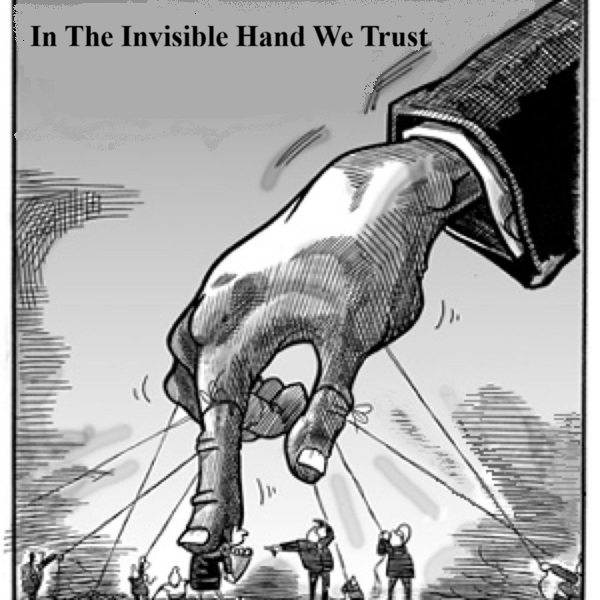
Smith observes that many fertile lands remain uncultivated or poorly improved, while capital is often directed instead toward distant commercial or speculative ventures. This undermines the notion that in Smith every private calculation is already socially beneficial. The “invisible hand” in his work does not operate in an empty space, nor in a world of large capital freed from all constraints, but within a community characterized by mutual trust, moral norms, and a certain degree of social control. The relationship between the baker, the butcher, and the customer is not the same as the behavior of large merchants and capital owners on broader markets. When only the metaphor of the “invisible hand” is extracted from his complex analysis, what remains is a neoliberal slogan rather than Smith.
A third weakness of such readings is the notion that for Smith the state was almost exclusively an obstacle to economic life. This too does not correspond to what he actually wrote. In Book V of The Wealth of Nations, Smith clearly lists the key public functions of the state: national defense, the administration of justice, the construction and maintenance of public works and infrastructure, and even education as a matter of general social benefit. In other words, for Smith the market does not function in an institutional vacuum.
The portrayal of Smith as an opponent of the state therefore represents a serious misunderstanding of his work. Smith was not an advocate of laissez-faire in the sense of the complete absence of regulation. The very term originates with the physiocrats, and Smith neither adopted it nor accepted their utopian vision of the economic order. On the contrary, he was aware that markets, like society as a whole, rest on trust, stable rules, and institutions that ensure legal security. If merchants are left entirely to their own interests, the result may be precisely the opposite of what advocates of an unregulated market expect: a tendency toward cartels, monopolies, and agreements against the public. For Smith, therefore, the problem was not the existence of the state as such, but its capture by particular interests and privileges.
At this point a deeper question arises. If Adam Smith himself, at the very beginning of modern capitalism, clearly saw that people of the same trade are inclined to collude against the public and raise prices, then it becomes difficult to claim that monopoly, oligopoly, and economic concentration are merely later distortions of an otherwise healthy market order. On the contrary, Smith already observed the tendency of economic actors, whenever the opportunity presents itself, to restrict competition and exploit their position against the common interest.
A fourth error is the idea that free trade naturally leads to peace. This is one of the most persistent liberal illusions. Already in the mid-nineteenth century Marx warned that free trade does not eliminate class antagonisms but intensifies them, and that the expansion of the market also means the expansion of exploitation. From a Marxist perspective, the world market does not neutralize force but rather gives it new forms. Wars, sanctions, bloc divisions, and geopolitical coercion are therefore not external malfunctions of an otherwise harmonious order, but enduring mechanisms of its reproduction on a global scale. For that reason it is mistaken to contrast an imagined liberal peace with contemporary “neo-illiberal” conflicts, as if colonialism, imperial trade, and the military protection of markets were historical accidents rather than integral parts of capitalist development.
Smith himself, however, did not view trade in such naïve terms as this liberal picture of the world suggests. Although he defended freer trade against mercantilist restrictions, he made important exceptions, above all when defense was concerned: his well-known statement that “defense is of much more importance than opulence” shows that trade was not for him an absolute principle to which everything else must be subordinated. Moreover, his attitude toward colonial trade was far from idealized. Smith clearly understood that behind the language of commercial freedom there often lay monopoly, privilege, and imperial coercion. It is no accident that he described the rule of trading companies in the colonies as “perhaps the worst of all governments for any country whatsoever.” It is therefore all the more surprising to derive from Smith the simple equation according to which global trade by itself produces universal peace.
A fifth weakness of such interpretations is the neglect of the class nature of the state. In Lakićević’s account, the problem seems to arise only when particular leaders begin arbitrarily to change the rules of the game. The Marxist problem, however, runs deeper: the rules of the game in capitalism are never neutral, because the state is not merely the guardian of free exchange but the institutional framework for the reproduction of property and accumulation. Smith, of course, was not a Marxist, but neither was he a theorist of class harmony. He saw labor as the source of value, yet also showed that workers must share the product of their labor with classes that do not produce commodities but appropriate income through ownership. He wrote about those who have the right to “reap where they never sowed,” about civil government as linked to the defense of property, and about the “vile maxim of the masters of mankind”: “all for ourselves, and nothing for other people.” It is difficult to derive from such an author the image of a naturally harmonious liberal order. On the contrary, even without Marxist terminology, Smith clearly understood that economic inequality produces inequality of political influence.
A sixth error lies in the moralization of history and the neat separation between “good” liberalism and its alleged distortions. In the article, the collapse of the neoliberal project is explained in almost personalistic terms: Trump, Putin, and Xi, together with their satraps, appeared and dismantled the universal liberal order, thereby bringing an end to the idea of the “end of history.” Yet such a picture is both theoretically and historically far too tidy to be convincing. Neoliberalism is not an external negation of liberalism, but one of its historical forms, arising at a particular stage of capitalist development and under the pressure of its internal contradictions.
A Marxist approach would therefore ask a different question: why have precisely such political forms become functional for capital in a period of prolonged stagnation, geopolitical fragmentation, and declining legitimacy of the liberal center? In other words, Trump, Putin, and Xi are not primarily the cause of the crisis of the liberal order, but symptoms of the fact that the liberal center can no longer stabilize its own contradictions through the old instruments. Here the consequence is taken for the cause, and structural problems are replaced by the psychology of leaders.
For this reason, the problem with Lakićević’s text is not only that it simplifies Smith, but also that through such a reading it reproduces a broader liberal illusion: that capitalism naturally tends toward equilibrium, peace, and the common good, and that crises arise only when political actors deviate from its “normal” course. Marxist critique begins from the opposite premise. Capitalism does not tend toward free harmony but toward accumulation, concentration, class domination, and periodic crises.
In this sense, the neoliberal project did not collapse because it was destroyed by Putin and Xi, nor because certain leaders deviated from Smith’s supposed message. It collapsed because it attempted to present a historically limited and deeply contradictory form of capitalism as a universal model of freedom, peace, and reason.
In one respect, however, I would agree with Lakićević: Adam Smith remains relevant today, perhaps even more so than in many earlier periods. But he is not relevant as a moral model for contemporary liberalism, nor as the author of a ready-made blueprint for a new harmonious world. He is relevant above all because at the very beginning of modern capitalism he already perceived some of its deepest contradictions: the tendency toward monopoly, the political influence of property interests, social inequality, and the imperial distortions of trade. For precisely that reason Smith deserves to be read carefully and honestly—not as a prophet of neoliberal harmony, but as a thinker whose work can still serve the critique of the capitalist order.